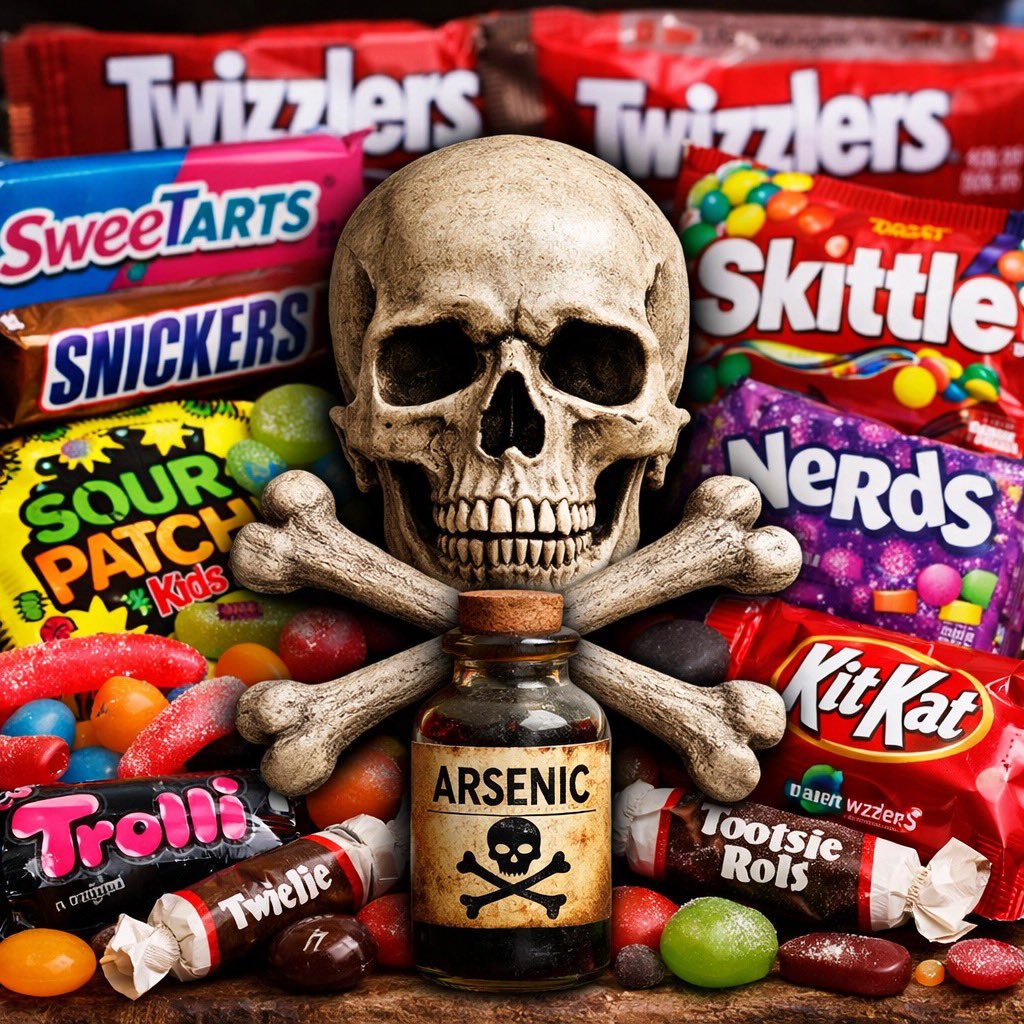
In medieval Europe, arsenic earned a chilling nickname: “the king of poisons.”
It was colorless, tasteless, and odorless—qualities that made it terrifyingly effective.
Mixed quietly into food or drink, it allowed poisonings to happen in plain sight, often without immediate suspicion.
For centuries, arsenic symbolized silent danger.
Today, arsenic is no longer associated with royal intrigue or shadowy assassinations.
Instead, it has reemerged in a far more unsettling place: foods marketed to children.
Arsenic in Children’s Candy
Recent testing conducted in Florida examined 46 popular candies commonly eaten by children.
According to the reported results, 28 of those products showed elevated levels of arsenic,
levels that researchers linked to increased cancer risk when exposure is repeated over time.
Even more alarming, the findings suggest that roughly 60% of popular children’s candies
tested contained measurable amounts of arsenic.
While individual servings may appear small, the concern lies in cumulative exposure,
especially for children whose bodies are still developing.
Worst-Offending Candy Brands Reported
Among the candies identified with higher arsenic readings were many household names,
often viewed as harmless treats:
- SweeTarts
- Snickers
- Skittles
- Kit Kat
- Nerds
- Sour Patch Kids
- Twizzlers
- Jolly Ranchers
- Trolli
- Tootsie Roll
These are not niche or obscure products—they are staples at birthday parties,
school events, and holiday celebrations.
Yearly “Safe” Intake Limits Based on Detected Levels
Based on the arsenic concentrations reportedly detected,
researchers calculated approximate maximum yearly consumption limits
for children to avoid exceeding safety thresholds:
- Nerds (Grape / Strawberry): 96 pieces per year
- SweeTarts Original: 48 pieces per year
- Sour Patch Kids: 36 pieces per year
- Skittles: 48 pieces per year
- Trolli Sour Brite Crawlers: 12 pieces per year
- Jolly Ranchers (Sour Apple / Strawberry): 6 pieces per year
- Twizzlers Strawberry: 4 pieces per year
- Tootsie Roll: 8 pieces per year
- Snickers: ~2.5 pieces per year
- Kit Kat: ~2.5 pieces per year
For many families, these numbers are startling.
A single Halloween bucket or movie night could exceed what is considered a “safe” yearly amount.
Why Arsenic Exposure Matters
Arsenic is a known carcinogen.
Long-term, low-level exposure has been associated with increased risks of cancer,
neurological effects, immune disruption, and developmental problems in children.
Because arsenic accumulates in the body, small doses over time can become a serious concern.
Children are particularly vulnerable due to their lower body weight,
higher food intake relative to size, and developing organs.
From History to the Present
What makes this issue especially disturbing is the historical irony.
Arsenic was once feared precisely because it was invisible and undetectable.
Today, it appears to have quietly returned—not in royal courts,
but in colorful packaging designed for kids.
Parents are left asking an uncomfortable question:
How did one of history’s most infamous poisons end up in modern candy?
Final Thoughts
Candy is supposed to be an occasional joy, not a source of toxic exposure.
While more transparency, testing, and regulation are clearly needed,
awareness is the first step.
Understanding what’s in everyday treats empowers families to make informed choices—
and to question an industry that has long marketed sugar-coated products as harmless fun.